PROJECTS
Client:
OrbitPayout Inc.
Year:
2025
Location:
US-based, remote
Service:
UI/UX Redesign
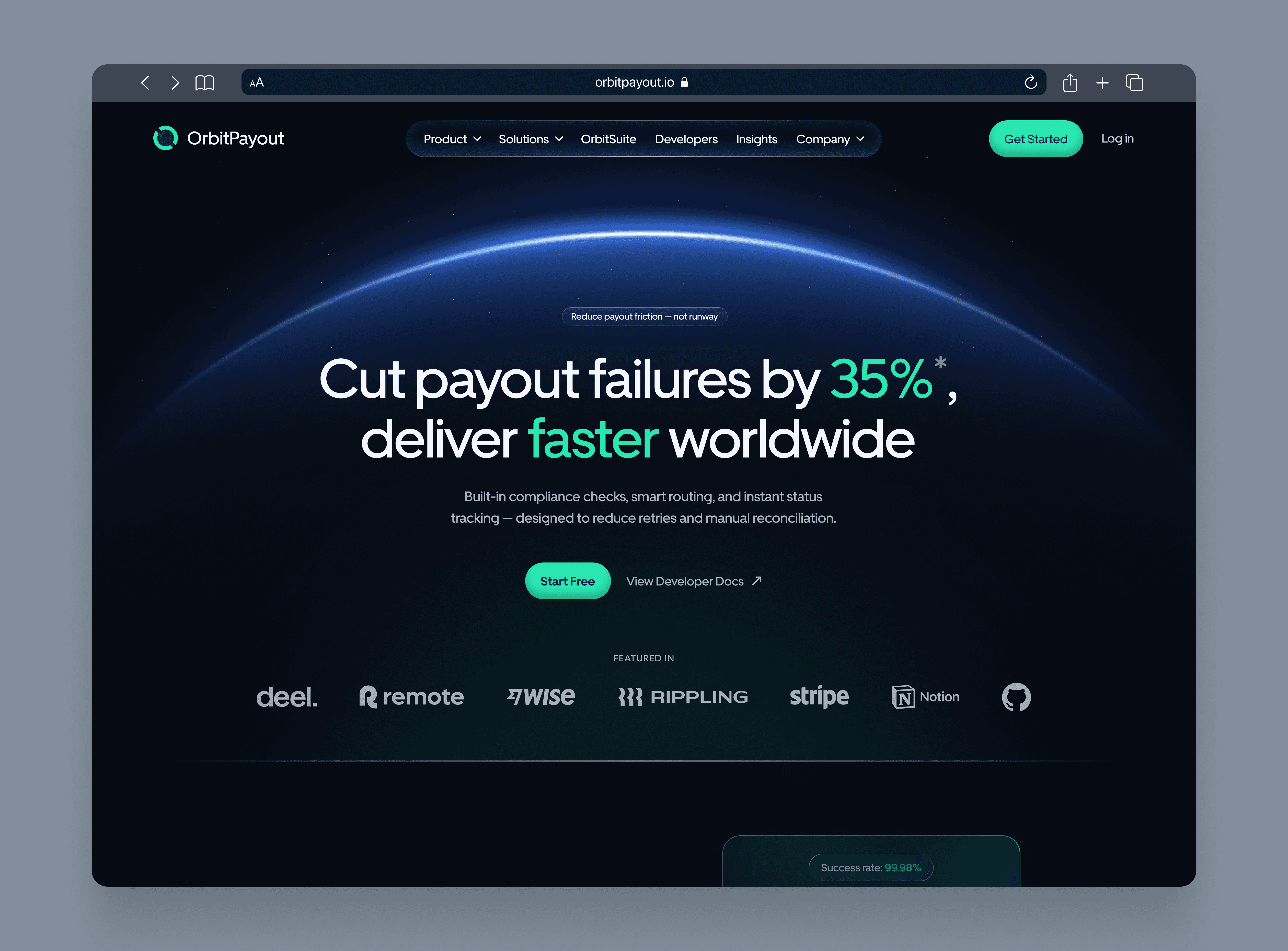
Project Overview
A conversion-first homepage for payout infrastructure — built to earn trust from finance teams and move evaluators to Start Free.
Client: OrbitPayout (US-based fintech)
Work: Homepage strategy + UX messaging + visual direction
Primary KPI: More qualified signups via Start Free
Audience:
Primary: CFOs, controllers, finance ops leads (risk-averse evaluators)
Secondary: Developers integrating payouts (time-to-integration evaluators)
Deliverables: Positioning pillars, section narrative, conversion architecture, page copy, UI-style “product evidence” components, UI Kit, responsiveness
Business context
Payouts are not a “nice-to-have” workflow. They’re operational risk. When payouts fail, businesses don’t just lose time — they lose trust, cashflow predictability, and internal confidence.
In this category, a homepage isn’t a moodboard. It’s part of the product.
A buyer landing on OrbitPayout is silently asking:
Will this reduce failures and manual cleanup?
Will this survive audit scrutiny?
Can I control approvals and access without creating new risk?
Will integration be fast, or will we drown in implementation?
Can I export cleanly into our accounting reality (not a fantasy)?
The business context (why this mattered)
Finance teams don’t need “more data.” They need:
clarity of priorities (what’s urgent vs noise)
confidence in decision-making (status, context, and risk are visible)
speed without mistakes (approve/schedule with guardrails)
audit defensibility (traceable actions, consistent states)
If the homepage can’t answer those questions fast, the deal dies early — even if the product is strong.
The challenge
OrbitPayout didn’t need “a prettier site”. They needed a homepage that:
leads with outcomes (not vague platform claims)
proves credibility without heavyweight corporate tone
speaks two languages at once: finance confidence + developer readiness
creates a clean path to conversion: one dominant CTA, no noise
This niche is brutal because the buyer's default is skepticism:
Too “startup-cute” = looks risky
Too corporate = looks slow and outdated
Too technical = loses finance
Too much marketing = loses everyone
Discovery & strategy
We treated the homepage like a product funnel — with an evaluator mindset.
1) Audience reality check
We mapped two distinct evaluation modes:
Finance-led evaluation (CFO / Controller / Finance Ops)
wants control, traceability, auditability
hates ambiguity and “trust us” language
needs a story they can defend internally
Engineering-led evaluation (Developer / Platform)
wants speed to integrate, docs, predictable behavior
will leave instantly if the site feels like a sales brochure
So the page had to do segmentation without splitting into two separate pages.
2) Competitive pattern teardown (category expectations)
We looked at how strong fintech infrastructure brands communicate trust:
outcome-driven heroes
short, structured proof
UI artifacts that look like real systems (states, logs, exports)
minimal marketing fluff, maximum operational clarity
Not copying “templates” — extracting what the market expects as baseline credibility.
3) Founder-level positioning questions
We aligned the story around strategic questions that matter in payouts:
What’s the real wedge: speed, reliability, compliance automation, reconciliation, or all of it?
What should OrbitPayout be in the buyer’s mind: payout provider or payout reliability layer?
What claims can we make that feel defensible without over-explaining?
4) Narrative architecture
We built the homepage as a sequence that matches how trust is built:
Hard outcome (why stay)
Operational proof (why believe)
Risk reduction (why it’s safe)
Finance-grade controls (why it’s adoptable)
Self-serve evaluation (why it’s easy to approve internally)
Final consolidation (why click Start Free now)

The solution: “Product evidence” storytelling
The core decision: we didn’t want the page to sound smarter — we wanted it to feel safer.
So instead of long explanations, we used a consistent system:
Outcome headline (metric / promise)
Short, plain-English proof
A single UI artifact that looks like something finance teams recognize (statuses, logs, DR/CR, exports)
Micro-CTA for the reader who needs depth — without breaking the conversion flow
This keeps scanning fast and credibility high:
Scannable list with consistent status system
Split-view details so users can decide without bouncing between pages
Clear primary actions: Approve / Schedule / Reject
Activity timeline supports trust + audit readability
Homepage breakdown
Hero: Outcome first — then proof
Headline: Cut payout failures by 35%, deliver faster worldwide.
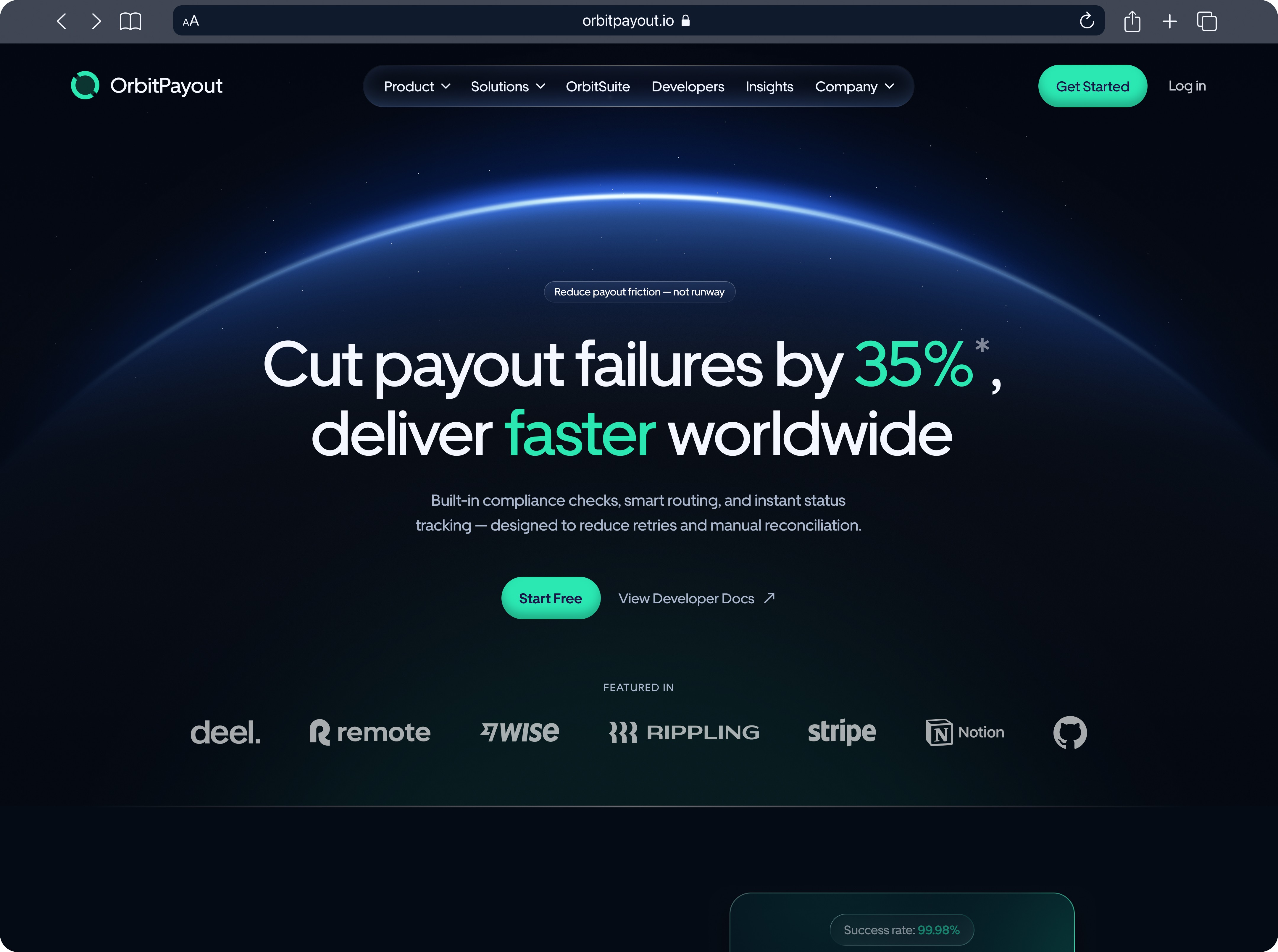
Why this hero works
In payout infrastructure, nobody buys “a platform.” They buy fewer failures, fewer retries, fewer reconciliation headaches, and fewer “where is the money?” tickets.
So we framed the hero around a measurable outcome and reinforced it with a simple “how” stack:
compliance checks
smart routing
instant status tracking > reduces retries and manual reconciliation
Conversion architecture
We kept the CTA logic brutally clean:
Primary: Start Free
Secondary: View Developer Docs
Two intents. No noise.
And we placed social proof directly under the CTA — exactly where the brain asks, “Is this legit?”
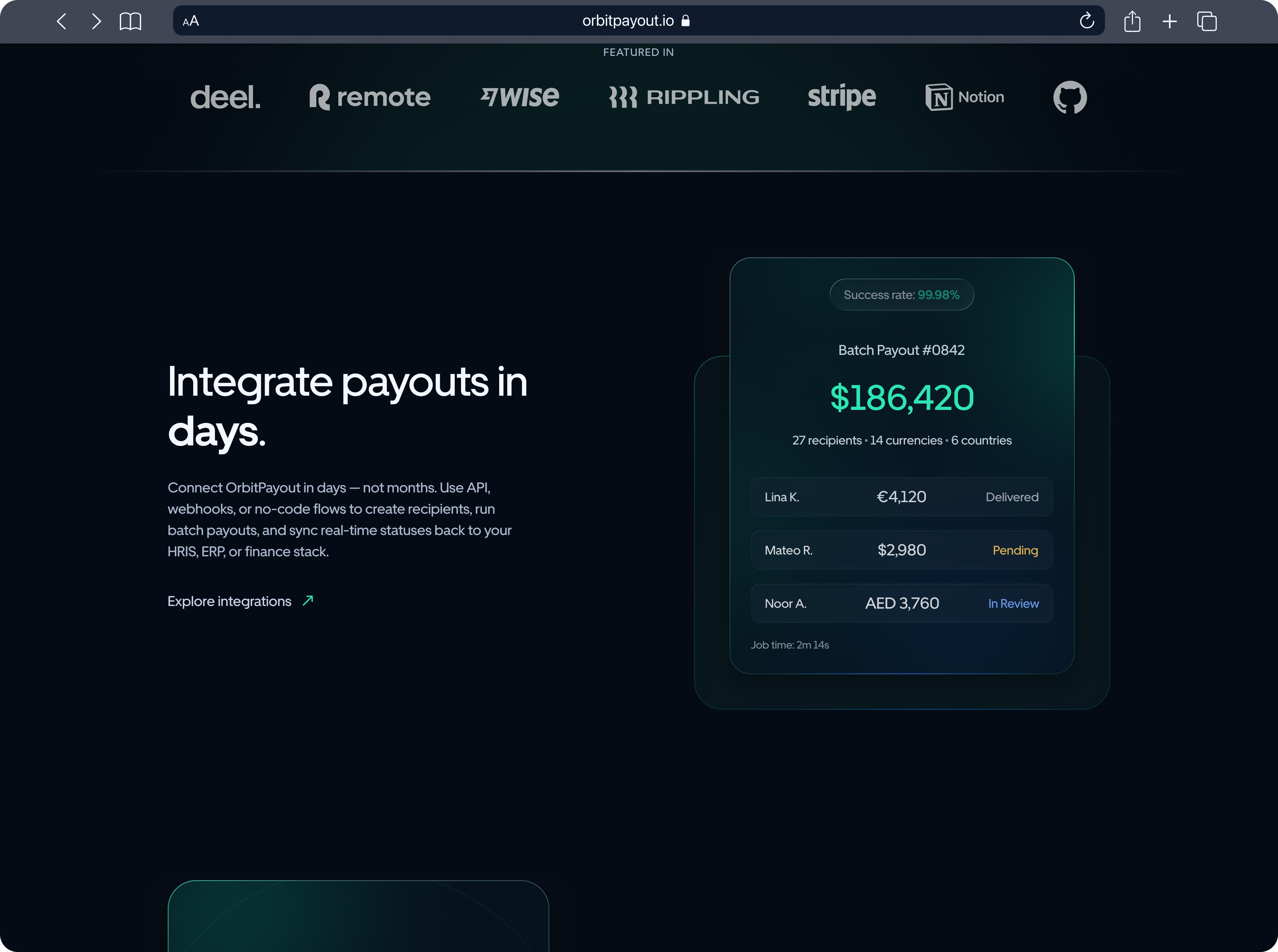
Integrate payouts in days — not months
Business goal
Kill the hidden objection that blocks adoption before it starts:
“Integration will be slow, messy, and expensive.”
What we communicated
OrbitPayout integrates via API, webhooks, or no-code workflows
Not as a feature list — as a workflow outcome:
create recipients
run batch payouts
sync statuses back into HRIS/ERP/finance stack
Why the UI artifact matters
The payout card isn’t decoration. It’s operational credibility:
batch amount
recipients / currencies / countries
live statuses (Delivered / Pending / In Review)
That’s what a finance team needs to believe it can run.
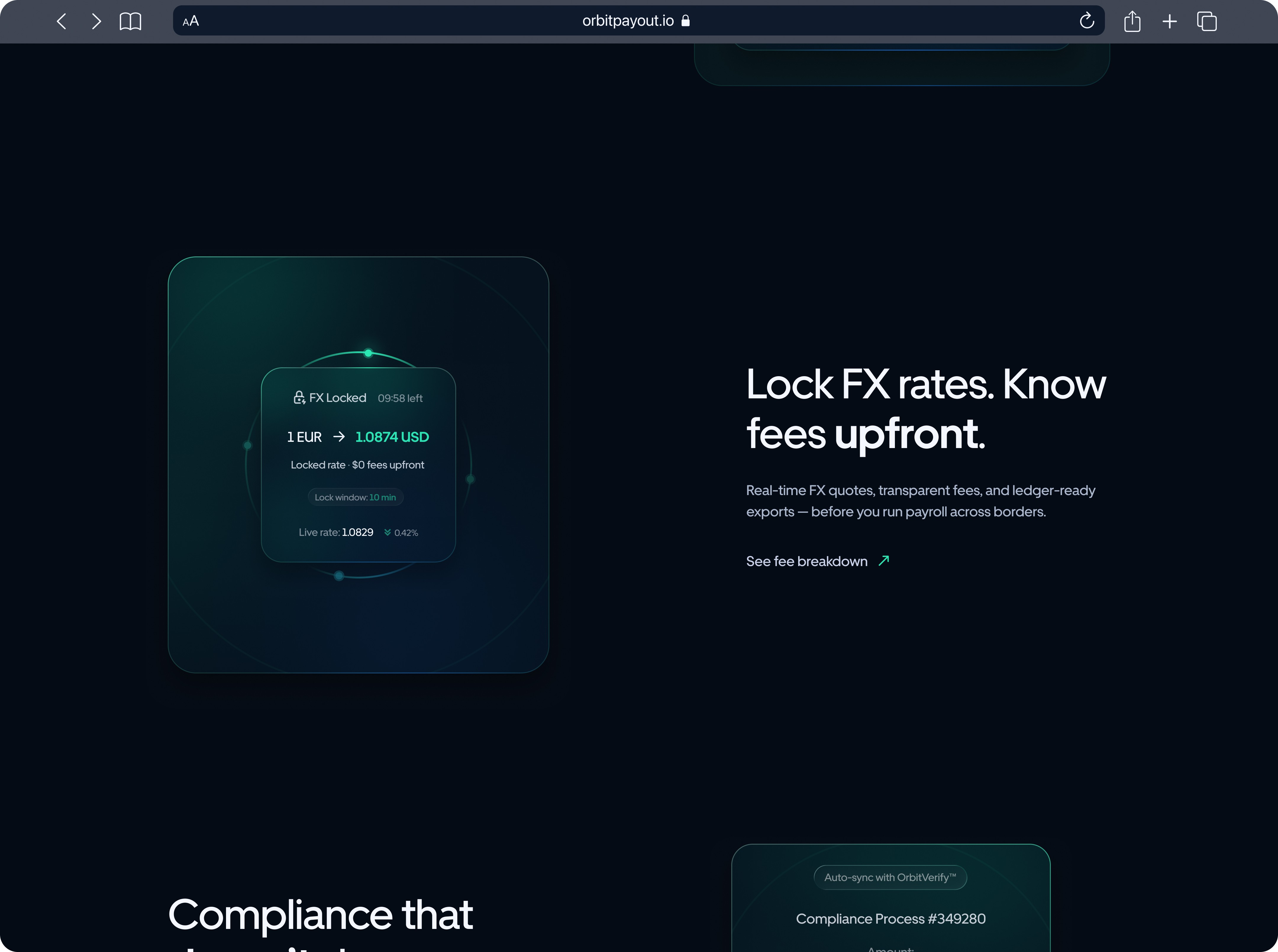
Lock FX rates. Know fees upfront.
Business goal
Sell predictability — the currency finance teams actually care about.
What we communicated
FX is where trust dies. If the buyer expects surprises, they assume you’re hiding margin or complexity.
So we positioned this as:
lock FX rates
transparent fees
ledger-ready exports before payroll runs across borders.
Why the visual works
The FX widget communicates control through real signals:
locked vs live rate
time window
fees upfront
timer state (implies governance, not chaos)
Short copy + clear proof = trust.
Compliance that doesn’t slow you down

Business goal
Turn compliance from a blocker into a competitive advantage.
What we communicated
Compliance is only impressive when it’s operational:
KYB/KYC
sanctions screening
rules by region
fewer failed payouts
audit-ready from day one
We also named the module (OrbitVerify) because serious infrastructure has named systems — not “trust badges.”
Why the UI artifact matters
We show compliance as a process with states:
checks running / completed
geo-screening results
entity & beneficiary checks
risk score
This makes compliance feel like built-in automation, not extra work.
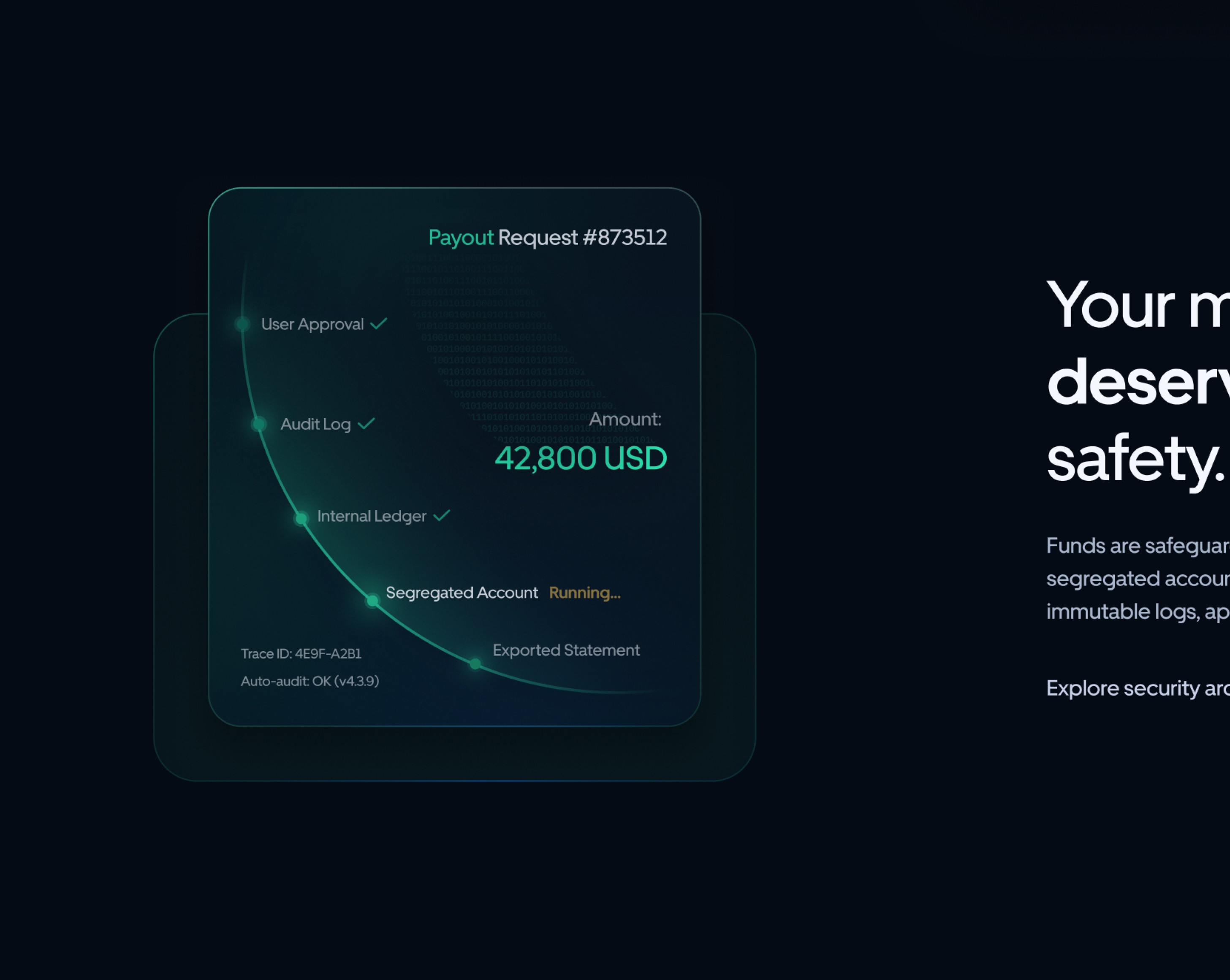
Your money deserves better safety
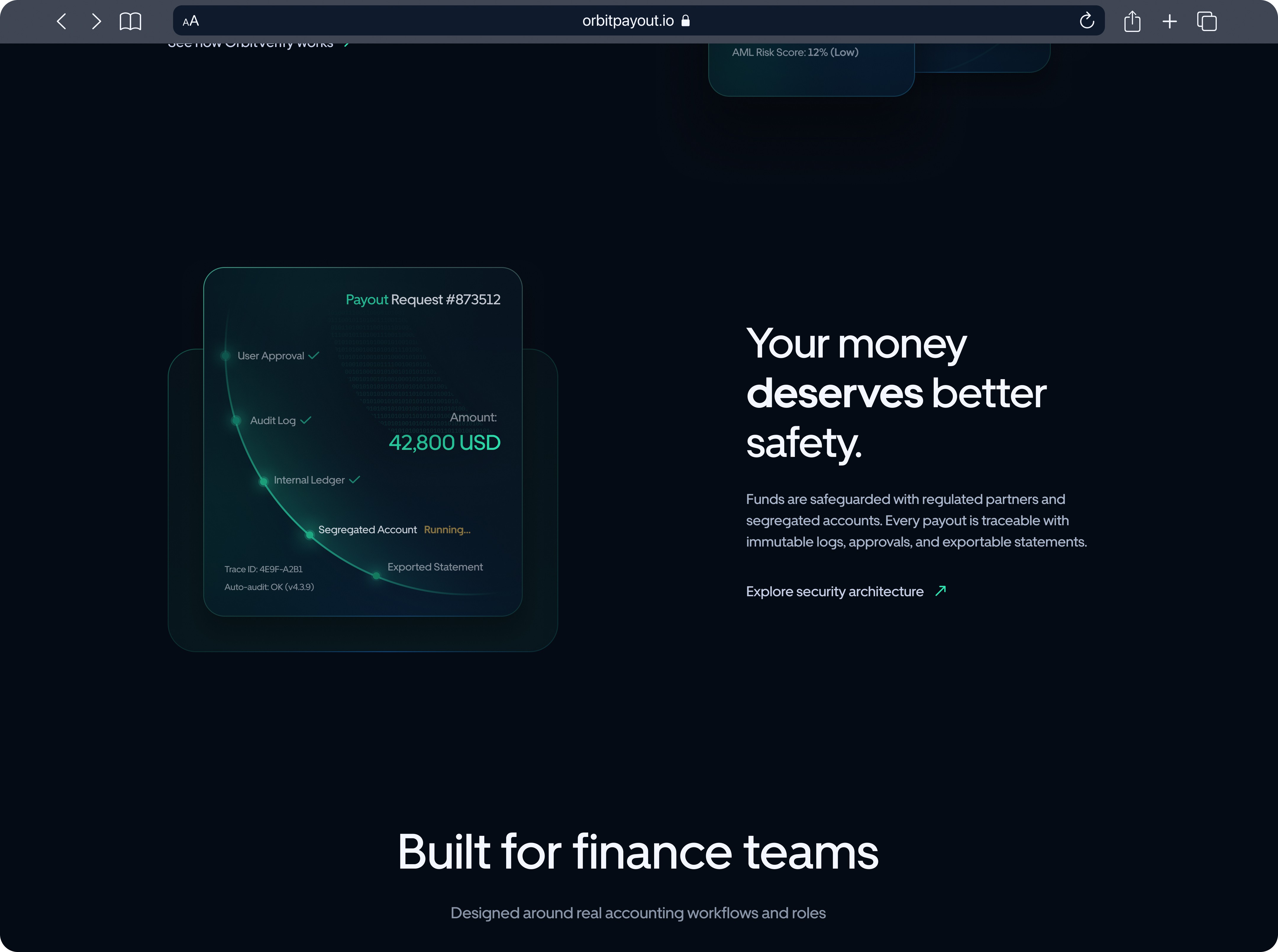
Business goal
Prove the system is designed for protected funds and defensible operations.
What we communicated
No “bank-grade security” clichés. Concrete mechanisms only:
regulated partners
segregated accounts
immutable logs
approvals
exportable statements
Why the visual works
It reads like a safety checklist you’d expect in finance:
approval
audit log
internal ledger
segregated account
exported statement
Security becomes visible and believable.
Built for finance teams
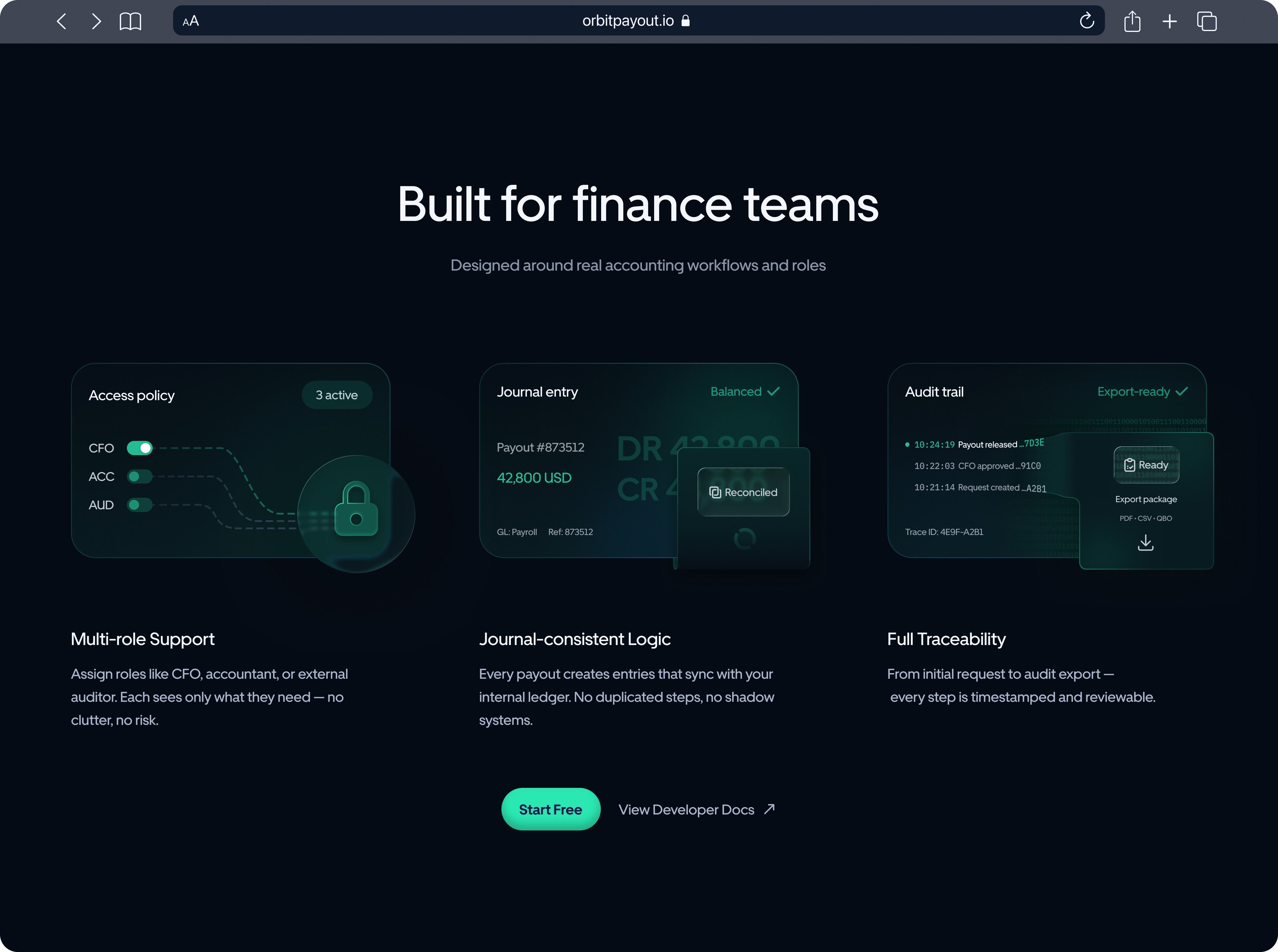
Business goal
Push the product upmarket in perception: from “payout tool” to finance-grade system.
We structured this as three credibility pillars:
Multi-role support
CFO / Accountant / Auditor roles
least-privilege access
no clutter, no accidental risk
Journal-consistent logic
payouts generate entries that reconcile cleanly
reduces “shadow spreadsheets” and duplicated steps
DR/CR language is instantly familiar and trust-building
Full traceability
every action is timestamped and reviewable
export-ready isn’t a claim — it’s a state
the audit trail is presented as a first-class system output
This section is where evaluators stop thinking “cool site” and start thinking “this can be adopted.”
Insights & playbooks

Business goal
Support long-cycle evaluators and internal buy-in without forcing a call.
We positioned content as:
practical playbooks (approvals, audit trail hygiene)
compliance-ready checklists
product updates that reinforce the finance narrative (PDF / CSV / QBO)
This does three jobs:
builds authority
reduces “unknowns”
gives teams shareable assets for internal approval
Content here isn’t SEO fluff. It’s an evaluation tool.
Questions, answered (FAQ)
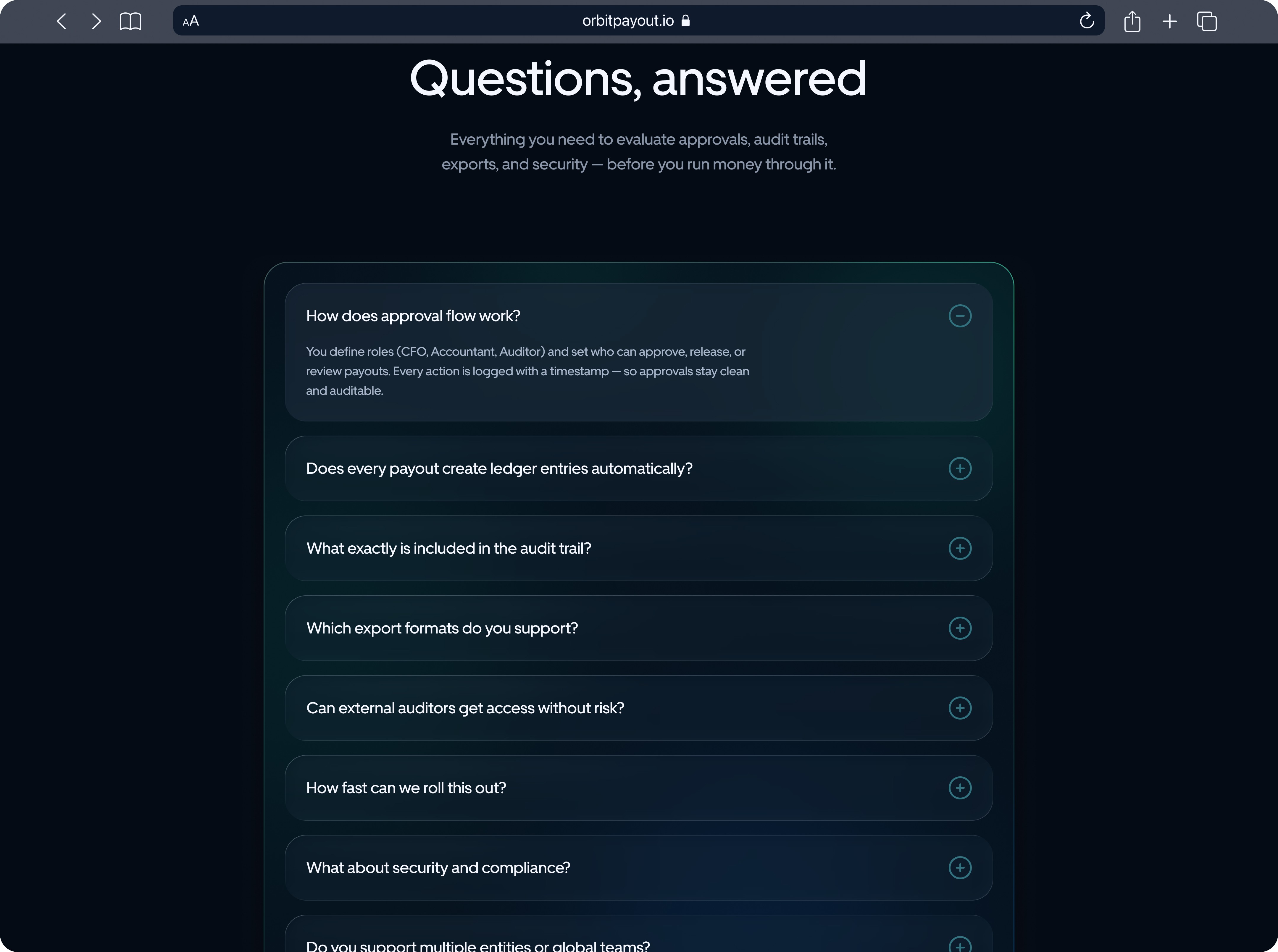
Business goal
Remove conversion friction by answering the exact questions that stop adoption:
approvals and roles
ledger entry automation
audit trail scope
export formats
safe auditor access
rollout speed
security and compliance
multi-entity / global teams
And we ended with two clean escape hatches:
Talk to us (high intent)
Open Help Center (self-serve intent)
This reduces sales dependency and keeps the page conversion-ready.
Final CTA: Ready to run payouts like a real finance system?
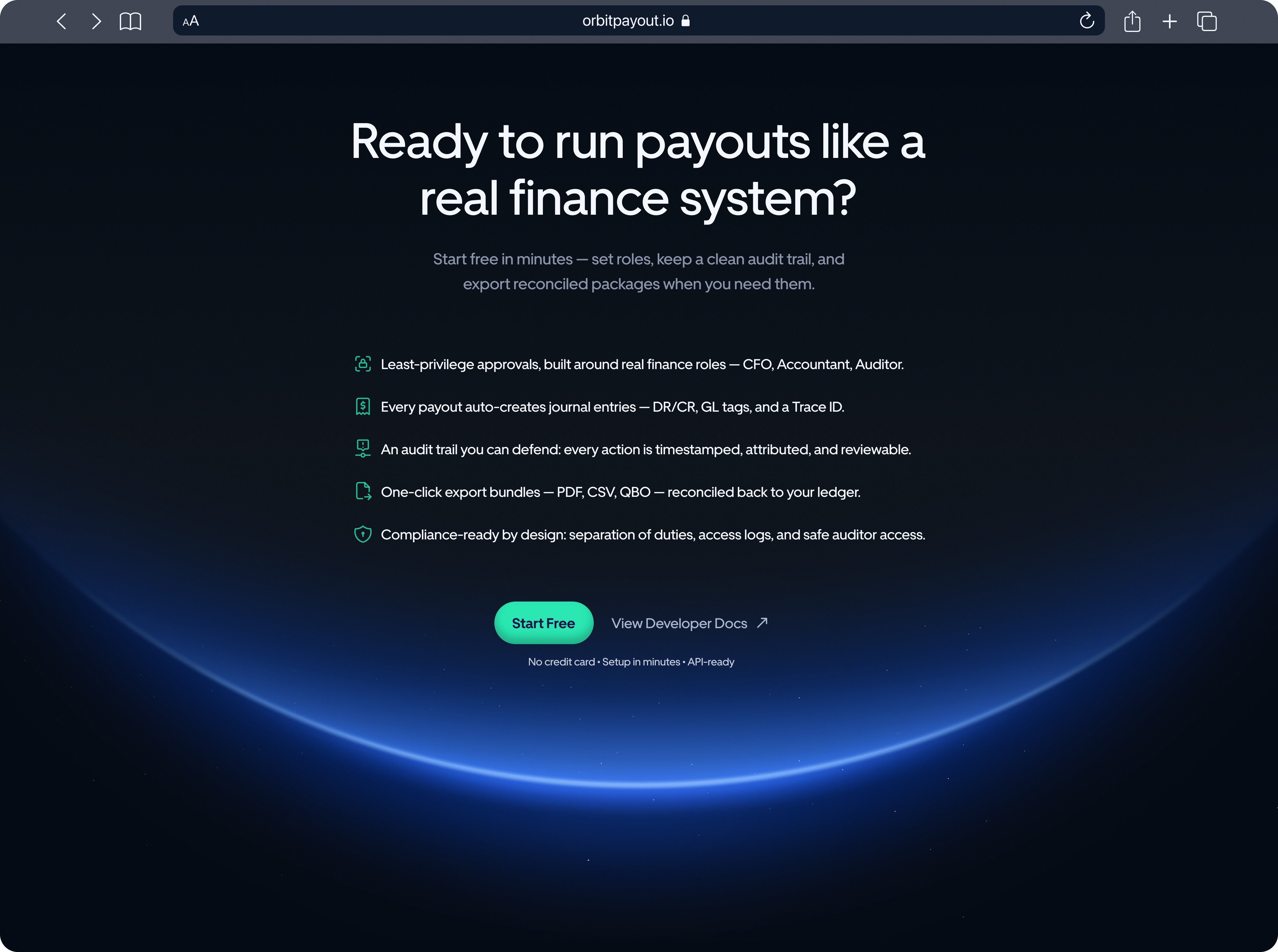
Close with a “system summary” that makes the click feel safe.
Instead of repeating the hero, we consolidated the strongest proof points:
least-privilege approvals around real roles
automatic journal entries (DR/CR, GL tags, Trace ID)
defendable audit trail (timestamped, attributed)
one-click export bundles (PDF, CSV, QBO) reconciled to the ledger
compliance-ready by design (separation of duties, access logs, safe auditor access)
Then we reinforced the final trust signals: No credit card · Setup in minutes · API-ready
Why this homepage performs
This redesign works because it’s not trying to impress — it’s designed to convert skeptical evaluators.
It leads with measurable outcomes, not generic positioning
Every major claim is paired with evidence, not adjectives
It speaks finance-native language (audit trails, roles, DR/CR, exports)
It supports the buyer committee: finance and engineering can both evaluate quickly
It keeps one conversion path dominant, with self-serve depth for serious readers
End result: OrbitPayout doesn’t just look modern.
It feels operationally credible — and that’s what sells payout infrastructure.

PROJECTS